
Falling Down
The statistics on falls are frightening for those of us over 65.

“I’ve fallen and I can’t get up!”
Edith Fore, a retired nurse in a 1990 LifeCall commercial
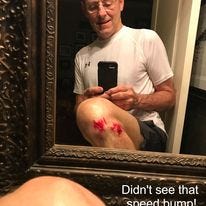
Bipedal locomotion of us humans requires a complex interplay of vision, depth perception, an intact musculoskeletal system working in a coordinated fashion, and a functioning vestibular apparatus in the inner ear. All must work together. Without any one of these, our efforts at walking upright would be a process of falling continuously or, at best, closely mimicking the staggering of a drunken sailor. Bipedal locomotion, by raising our center of gravity and providing only two-point contact with the ground, places us at risk for falls that quadrupeds avoid. Even when all systems are in perfect working order circumstances can precipitate a fall. I know this from personal experience.
I never concerned myself with falling when I was younger, but now that I am older, it is a recurring concern.
The first fall that comes to mind was in my 50’s when I was running in the early morning hours before sunup. When practicing as a plastic surgeon, I went for a morning run most mornings in the dark. I did not have a light but I wore a reflective vest. On this day, I was on the right shoulder when I heard a car coming up behind me and the distant sound assured me I had time to cut over to the left side of the road to give it plenty of time to pass. I did not realize that my left shoelace had come untied and, as I veered to the left, I stepped on it and face-planted in the road. The car swept by me with what seemed to be inches to spare. I do not know if the driver was even aware of the close call. I got up shaken and resumed my run. I have always double-tied my shoelaces since.
The next time, I was running on the left shoulder around a local lake, on a dark, moonless morning. I saw headlights coming towards me and decided to step off the road onto the grass to give room for the car to pass. I did not realize that the homeowner had placed basketball-size pieces of rough coral rock spaced about 3-4 feet apart to keep cars off the lawn. I tripped over the first one and flew headlong into the next one, striking it face first. All that saved me from a broken neck, face, or both was that I reflexively put my arms out in front. My hands hit the ground on either side of the rock and my arms cushioned the blow sufficiently that, even though my face hit the rock, my injury was limited to multiple superficial lacerations and bruising. I ran home with warm blood running down my face. This scared me enough that I never ran again in the dark without a bright headlight.
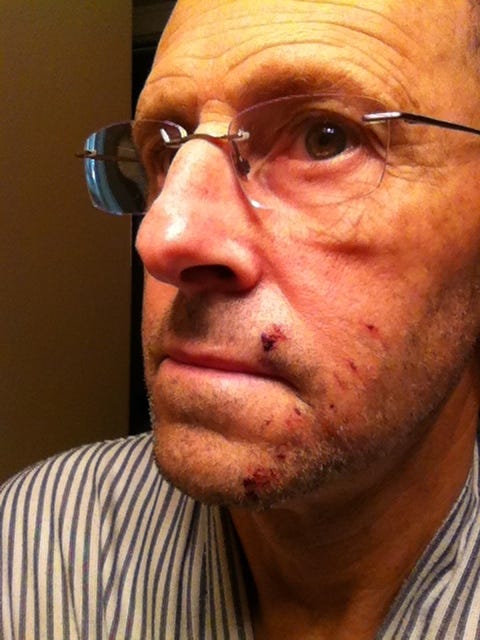
There have been other falls. Twice I have run into objects with my head, knocking myself down and nearly out. These occurred on daytime runs when I was looking down and not ahead. I now always scan ahead for low objects. I have also had a number of stumbles but caught myself before hitting the ground. I almost tripped over a six-foot alligator in the road one morning. Yes, I suppose you could say I am accident-prone when running.
Every fall comes as a blindside. My most recent fall was not while running at all, but rather doing chin-ups in my closet this weekend. My chin-up bar locks into the door jamb, and I used it uneventfully for years until I replaced it with a newer, identical, one, or so I thought. The new one was of metal, not wood, and clearly did not lock into place as solidly because, when I pulled myself up, the unit fell off the door jamb, landing me on my back and shattering a plastic footstool into pieces. The family out in the living room thought it was the sound of a rocket launch at the Kennedy Space Center 70 miles away! Fortunately, as in the past, I escaped serious injury.
What prompted this musing on falling down was recently reading, A Leg to Stand on, by Oliver Sacks, a physician who recounts his experience severely injuring his leg in a fall and his observations during his lengthy and unusual recovery. I highly recommend it.
My father passed away at the age of 93. Until he turned 90, he was in excellent health except for some arthritis and had never had a serious injury. Every year thereafter, he sustained a serious injury from a fall in his apartment fracturing, successively, his right hip, multiple left ribs, and right shoulder. He spent a large part of those three years in rehabilitation. The shoulder fracture ended his independent living.
My community has a preponderance of retirees, hence older adults. When I was in practice, one of the common emergencies seen in the emergency room was that of an elderly man or woman who fell at home and could not get up. Some had lain on the floor for days before being discovered. Some developed serious kidney failure from muscle breakdown. Others developed huge bed sores. Some died before help came.
Falling has become a concern of mine as I grow older and choose to remain active. I have not injured myself seriously in any of these falls, a fact that I attribute to generally good fitness and resiliency built on years of staying very physically active. A maneuver I practice twice weekly at the gym is to sit cross-legged on the floor and stand up in one smooth motion without using my arms. It is a measure of strength, flexibility, and balance. Most of the time I succeed.
The statistics on falls are frightening for those of us over 65, with falls the leading cause of injury and death in this demographic. More than one out of four adults over 65 sustain a fall each year. The 5-year survival after a fall resulting in a broken hip in someone over 65 is the same as that of some of the worst cancers.
I know I will fall again. The question is when and how, and for how long will my resilience protect me. The thought is rarely far from my mind.
Richard T. Bosshardt, MD, FACS
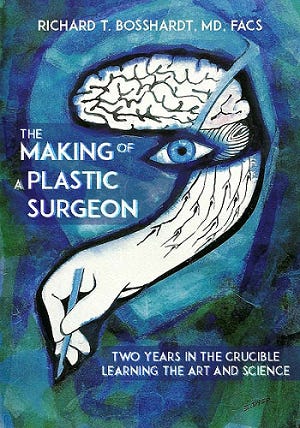
If you have ever had or considered a close encounter with plastic surgery, check out my book available on Amazon in eBook or paperback.
Count your blessings and luck. Yes, that could have been much worse. I spend a lot more time on strength and balance training on my legs to help combat that increased risk. Our peers with the chicken legs at the gym help motivate me as well. Stand tall my friend.