
My First Beau(gregory)
Life is full of firsts. Some are unforgettable.

(A recent trip to the Florida Keys with friends to do some diving and fishing took me back nearly half a century with memories of a time of youthful discovery and exploration, and very nearly set me on a path to be a marine biologist. Although I eventually changed to medicine, the love of the ocean and its incredible biodiversity never went away.)
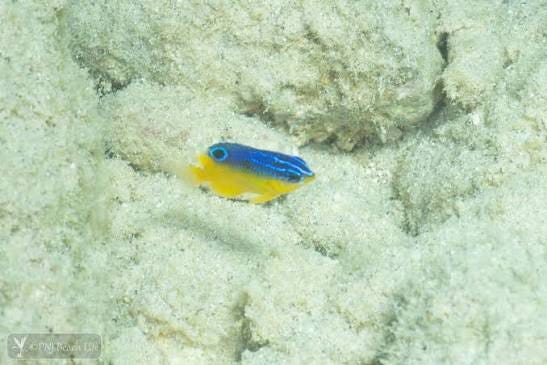
The brilliant blue dot hovering over sand could not have been more spectacular if it had been a gleaming Ceylon sapphire. I would not have regarded it with any more awe if it had been. Instead, it was a tiny, half-inch damsel fish in the shallows of Matecumbe Key in the Florida Keys. Juvenile beaugregories are an iridescent blue in the upper half of their bodies and lemon yellow on the underside. In the sunlight they catch the rays and reflect back no less than a perfect, polished jewel. I was mesmerized, never having seen anything more beautiful.
I came to be there at the invitation of a classmate when I was in ninth grade. Devon and his father had a saltwater aquarium in their home and ventured to the Keys on weekends to catch tropical fish. I had snorkeled a years earlier but only in dirty water at a beach near my house. I had no gear so my parents took me the week before to purchase a mask, snorkel, and fins. In a moment of optimism, I also bought a small hand net of fine mesh, hoping to catch something myself.
Early Saturday morning we headed to the Keys, driving along the overseas highway through Key Largo and assorted smaller keys connected by bridges until we reached Matecumbe Key. We parked on the shoulder (something you cannot do today) of the road. There was no beach, just a narrow strip of grass and a line of dried seaweed at the water’s edge giving off a fishy smell that I soon came to love. Looking across the shallow flats, the color variation indicated the nature of the bottom- blue/white for sand, dark green for turtle grass, brown/yellow for rocks and coral. Further out the ocean turned the darker indigo blue of deeper water. It was stunning.
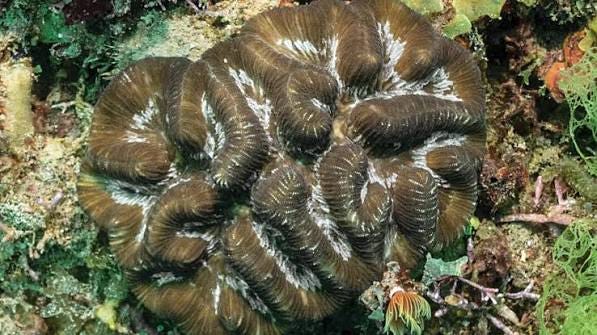
Devon’s dad inflated a small yellow life raft. Behind it he tied an inner tube and inside this was a laundry basket sewn all around with vinyl screen material to serve as a live well in which to keep any fish or coral we collected. We set out in a straight line from shore over the flats. The sea was calm with tiny wavelets, barely enough to ripple the surface. The sky was brilliantly blue and cloudless. To my unpracticed eye, the water was amazingly clear. The bottom consisted of scattered bottle brush and other plants, waving purple, green, and yellow gorgonian corals, bright purple sea fans, interspersed with irregular “live” rocks ranging from the size of a brick to steamer trunk and festooned with soft and hard corals. The rocks always harbored large numbers of small fish seeking their protection. On the sandy bottom were scattered, scalloped oval pieces of hard coral I came to know as rose coral. Assorted other small corals grew on the rocks and bottom. Large patches of turtle grass covered acres.
It wasn’t five minutes and no more than one hundred feet from shore, in perhaps 2-3 feet of water when I spotted the blue jewel next to a rock. I lifted my head, spit out my snorkel and urgently shouted to Devon to come over and see this marvel.
“Oh, its just a baby beaugregory,” he said, “We aren’t looking for those.” Amazing!
“Just a beaugregory.” I wanted a closer look and tried to catch it in my net. The little creature was surprisingly elusive and eventually I gave up and swam to catch up to Devon and his dad. As I swam by the laundry basket, I looked in and beheld another jaw-dropping creature of unsurpassed beauty. If anything, it was more striking than the beaugregory although I would not have thought that possible.
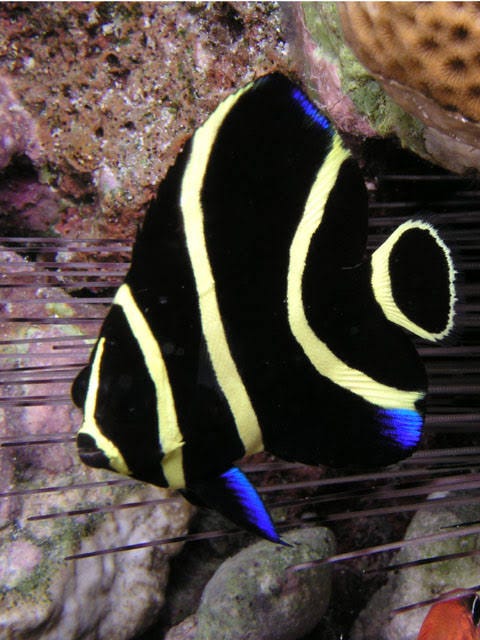
Devon later identified this as a juvenile French angelfish, a very desirable catch indeed. It was jet black with brilliant yellow stripes and brilliant blue fins. It swam with a flowing motion, using its entire body and not just its fins. What possible evolutionary advantage did such gaudy, yet ethereal, beauty, provide? It seemed to be made solely for human appreciation.
And so went the day. We swam out perhaps a quarter mile or more off the shore and the depth never exceeded 7-8 feet. We ate our lunch of sandwiches sitting in the little raft. Devon and his father collected a couple more fish and a few pieces of rose coral and some brilliant orange live sponges.
That evening I went with them to their house to watch them place the fish and arrange the coral and sponges in their 25-gallon aquarium. It was stunning. The fluorescent light brought out the color in everything even more than the sunlight did. To this day, I remember it as the most beautiful aquarium I have ever seen. I must have stared at it for an hour or more and continued to find new things: small crabs, shrimp, worms, tiny anemones.
That trip set me on a quest that dominated nearly all of my spare time for the next several years of high school. Devon and his family moved to Puerto Rico and I never dove with him again, but I was joined by my best friend, Dave, and we spent every waking moment planning the next weekend’s trip to the Keys. We recruited our long-suffering fathers to take us until we were able to drive ourselves. At one time, between the two of us, we had several aquaria ranging from 350-gallons in Dave’s bedroom to a 50-gallon in my patio, and a plastic child’s wading pool containing two small nurse sharks in my garage. Needless to say, our mother’s put up with a lot.
In time I learned that tiny beaugregories grow into large, aggressive adults that do not get along well with other fish in an aquarium and I, too, passed them by. Even so, the sight of a shiny blue jewel on the bottom always transported me back to that first dive.
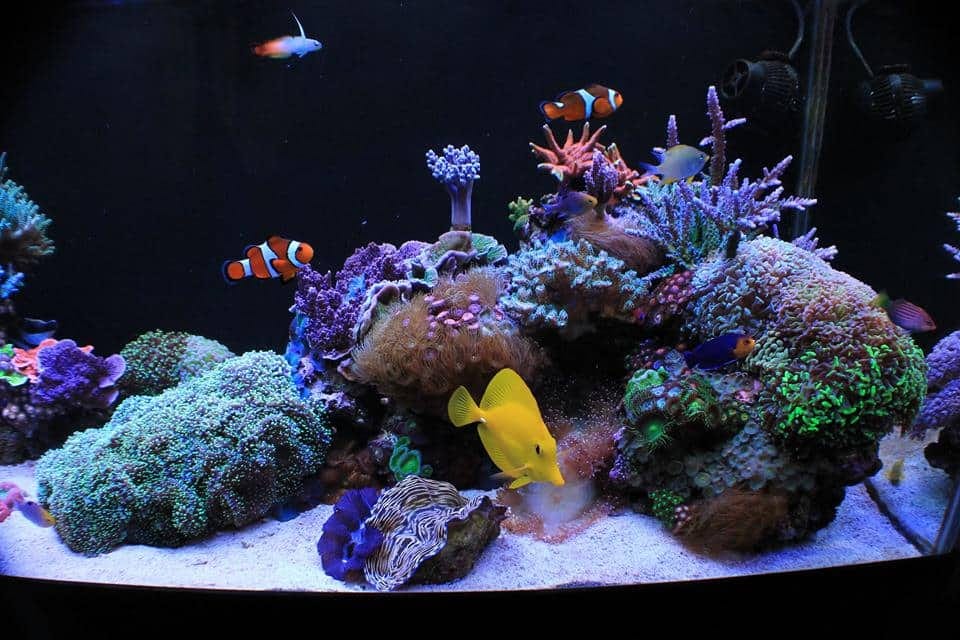
That was nearly 50 years ago. I have not had a saltwater aquarium since high school. Today, saltwater aquaria are marvels of science and technology. Most use artificial seawater. Fish can be kept healthy, sometimes for years. Corals and sponges can actually be grown in them. Things we could only dream of.
Check out some of the reef tanks online. You will be stunned.
Richard T. Bosshardt, MD, FACS

Check out my book for an unvarnished, entertaining, and informative peek into the fascinating and misunderstood world of plastic surgery.
You brought back SO MANY MEMORIES! I, too, wanted to be a marine biologist, had an aquarium and trained a trunk fish to follow my finger outside the aquarium until I placed it inside the water, with its bit of shrimp. Those were great days ☺️❤️
Creation ! Have heard we have more knowledge of outer space than the oceans. Fascinating.